AI Security
Five questions for any vendor with remote access to your clinical equipment
U.S. agencies now warn that internet-reachable refrigeration controllers are being targeted, days after France's blood service caught tampered cold stores in time. If a vendor can reach your equipment remotely, these five questions tell you whether that path is controlled.
November 10, 2026 · 7 min read
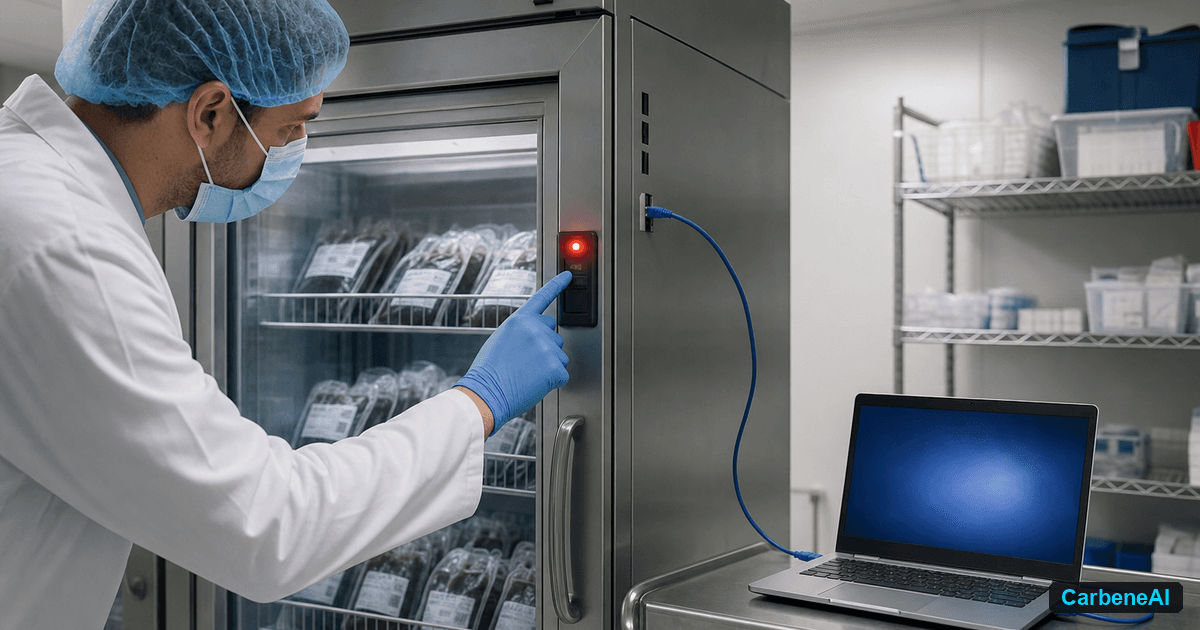
A refrigeration controller that can be reached from the internet is a clinical safety control with a login page. On November 5, CISA, the FBI, HHS, USDA, and DOT published a joint fact sheet warning of ongoing activity against industrial refrigeration and cold chain monitoring systems, and they list Healthcare and Public Health first among the sectors that rely on them. Three days earlier, France's national blood service had its own version of the problem.
I want to stay inside what the agencies and the reporting say, and I am not going to describe how these controllers get compromised beyond the categories the government named. The useful part for a hospital or a HealthTech vendor is the shape of the risk: a supplier's remote monitoring path reached equipment that holds products patients depend on. That shape fits a lot more than freezers.
What happened at the French blood service
According to The Guardian, the French blood service (EFS) said temperature and defrosting thresholds had been raised to "very high levels" at three cold stores holding blood products, and that its alarm systems let technicians intervene before the products were compromised. EFS said it was not directly targeted. The attacks hit cold stores run by its contractors, and the products in the affected rooms, plasma for transfusion and for medicine manufacturing, were moved to other sites. EFS alerted France's national cybersecurity agency and the health ministry and reinforced monitoring of all its equipment.
The Hacker News describes the same incident as one that affected a refrigeration equipment provider and pushed temperature and defrost settings to "extremely high levels" at three facilities used to store plasma. It also reports that supermarkets in a dozen European countries had refrigeration controllers tampered with in recent weeks. Both outlets say it is unclear who is behind the attacks.
Separately, a refrigeration rental company, Coolworld, posted a statement on November 4 saying an early November incident involved remote monitoring software, that the vulnerability "relates to a component from a third-party supplier," and that a limited number of its units were affected. Coolworld does not name customers, so I am not tying it to EFS. I mention it because it shows the layering that matters here: the hospital trusts the equipment vendor, the equipment vendor trusts a monitoring vendor, and the monitoring vendor ships a component from someone else.
The good news in the French case is the part that worked. Independent temperature alarms reached people who could act, and they acted before anything was lost.
What the joint fact sheet actually asks for
The fact sheet itself is three pages. It says the actors target unpatched or internet-accessible temperature and refrigeration controllers through authentication bypass, code injection, and weak configurations, and that the effects can include temperature changes, fire hazards, inventory loss, and a "denial-of-view condition" where operators lose visibility into current temperatures.
Its mitigations read like a checklist anyone can audit:
- Do not expose control system devices to the internet. If remote access is necessary, put it behind a firewall or edge device that is kept updated.
- Put OT devices on their own network segment, separate from business systems.
- Change default passwords and use phishing-resistant MFA wherever feasible.
- Keep firmware current and retire devices the manufacturer no longer supports.
- Allowlist the devices and IP addresses permitted to make changes.
- Keep tested offline backups.
- Turn on logging and review it, and collect network traffic where device logs are poor.
- Set safe setpoint limits for downstream equipment and alert on deviations.
Almost every item on that list depends on a vendor answering honestly. A hospital rarely configures its own cold-storage controllers or the remote monitoring around them. The vendor does, and the hospital inherits the result.
Five questions to ask the vendor
These work for refrigeration, but I would ask them of any vendor with a remote path into clinical equipment: infusion pump management, imaging modalities, lab analyzers, building systems in a pharmacy. Ask for the answer in writing.
-
How does your remote access reach our equipment, and is any part of that path reachable from the public internet? The answer should name the connection method and say plainly whether a controller or its management interface has a public address. "It's secure" is not an answer. A diagram is.
-
Who can sign in, and how? Ask whether every person at the vendor uses a named account, whether default passwords on the devices were changed at install, and whether MFA is required for anyone who can change settings. If the vendor's technicians share one login, you will not be able to tell who changed a setpoint.
-
What third-party software sits in your remote monitoring stack, and how do you patch it? The Coolworld statement is a reminder that the weak link can be a component the vendor did not write. Ask how they learn about vulnerabilities in those components, how fast they apply fixes, and which of the devices on your site are past the manufacturer's support date.
-
Are safe limits enforced at the equipment, and do our alarms work without your platform? A setpoint limit that the remote platform can override is a preference, not a limit. And if the only temperature alert runs through the same system that was tampered with, a denial-of-view condition leaves you blind. EFS caught the change because its alarms did their job. Ask whether yours would, if the vendor's system were the one compromised.
-
Can we see the change log, and can we cut your access ourselves? Ask for a record of every remote setting change with who, when, and what, available to you on request. Then ask how your own staff can disable the vendor's remote path in an emergency without waiting for the vendor to answer the phone.
What a good answer looks like
A vendor that has thought about this will answer quickly and with specifics: remote access through a gateway that requires MFA, no public management interfaces, named technician accounts, a component list with patch dates, hard limits at the controller, and a log export you can request. Some will say parts of this are on their roadmap. That is fine if it comes with a date.
A vendor that cannot answer question 1 has not looked. That is the one I would follow up on first, because the fact sheet's very first mitigation is to take these devices off the internet, and you cannot confirm that without knowing how the vendor connects.
On the hospital side, the same questions turn into two internal tasks. Find out which of your clinical systems have any vendor remote access at all, and make sure at least one alarm path for each critical storage unit does not depend on that vendor's platform.
A tabletop worth running
The French case is a clean exercise scenario because the outcome hinged on detection and response, not prevention. Put a facilities lead, a pharmacy or lab lead, someone from IT security, and the vendor contact in a room. The setup: an alarm fires overnight on a cold store, the vendor's portal shows normal readings, and nobody can reach the vendor for an hour.
Then ask: who gets the alarm, who has authority to move the products, who can disable the remote path, and who tells the vendor and the regulator? If the answers depend on one person's phone, or on a portal you just agreed might be lying, you have found the gap before an attacker did.